- Locations
- Find a Physician
- By Physician
- By Department
- The Center for Spine Health
- Hand & Wrist Center
- Shoulder & Elbow Center
- Foot & Ankle Center
- Joint Replacement Center
- The Sports Medicine Center
- Pediatric Orthopedic Center
- Trauma & Fracture Center
- Osteoporosis and Bone Health
- Oncology Center
- Cartilage Repair Center
- Concussion Rehab Center
- OrthoDirect
- Careers
- Patient Portal
- Intranet


Back Pain Prevention | Knee Pain Prevention
Back Pain Prevention
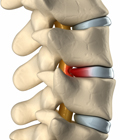
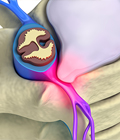
Once you encounter back pain whether it is low back pain, sciatica, or neck pain, you are four times as likely to experience it again. This is why prevention is essential to your long-term recovery.
One of the best ways to avoid back pain is by exercising and stretching. Low-impact aerobics, such as walking or swimming, is an ideal way to prevent or treat back pain. Stop if the exercise becomes painful, and always remember to stretch. Stretching is easy to incorporate into your daily routine. You can even do it in front of the television.
Below are some more specific ways to prevent back or neck injuries:
Sitting for long periods
The spine likes movement. Anything that puts the spine in a static position creates stress, which can cause back and neck pain. Every hour, stand, walk around, bend, arch backward gently, and twist. Doing so at regular intervals will lengthen the amount of time you can sit comfortably. Also, get an ergonomically-designed chair or an orthopedic insert to support your spine, especially if your job involves long periods of sitting. Or roll up a towel, and place it behind your low back.
A comfortable way to stand
Prolonged standing can also strain the back.
If you have to stand for long periods of time, prop one foot on
a small stool or telephone book to reduce stress in the low back.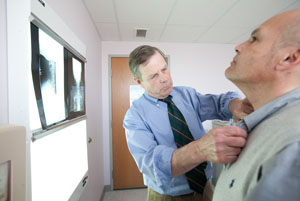 Alternate with the other foot. Every half hour, bend over and touch
your toes, with your knees slightly bent, or do some of the stretching
exercises shown in this Internet site. They will help
loosen your muscles, ligaments and joints.
Alternate with the other foot. Every half hour, bend over and touch
your toes, with your knees slightly bent, or do some of the stretching
exercises shown in this Internet site. They will help
loosen your muscles, ligaments and joints.
Plane rides
While traveling on a plane, it helps to raise your feet on a briefcase or a bag underneath the seat in front of you. Ask for a pillow to place behind your low back to improve lumbar support. It is important to get up frequently and walk to the bathroom and back, whenever possible. Avoid hour-long periods in your seat.
The best sleeping position
Avoid sleeping on your stomach, which arches your back and puts pressure on your spine. Instead, lie on your back with a small pillow tucked under your knees. This position unloads the spine. An alternate position is to lie on your side with a pillow between your knees. If you like sleeping on your stomach, place a soft, flat pillow under your stomach to eliminate some of the arch that can stress your back.
Mattress considerations
It is important to sleep on a mattress with optimal back support, whether it is a conventional mattress or a waterbed. Older waterbeds were mushy and provided little support. However, now there are waterbeds that allow you to adjust their firmness. A good mattress should relate to your body shape. Generally, go with what feels comfortable to you.
Pain is a signal from the body to the brain that something is wrong. Either the back is too weak, too inflexible, or the wrong body mechanics were used to perform a task.
 Driving
and Back Pain
Driving
and Back Pain
Muscles were designed to move and stretch. Sitting pulls muscles into a shortened position, causing stiffness. Also, the sciatic nerve, which runs between the spine and thighs, can be compressed by the weight of sitting for a long time.
Just like at a desk job, driving for a long period of time can cause strain on the back. Many seats in cars are designed to support the spine properly, but even if your car was designed ergonomically, your height may differ from the height of the person the seat was designed for.
Be sure to remove your wallet from your back pocket before a long drive, as it can place pressure on the sciatic nerve. To prevent back pain, stop and stretch every hour or so to keep muscles loosened up. Feel it out. If your back hurts after a long drive, roll up a towel and place it behind your low back to support the lumbar spine.
 Lifting
Heavy Objects at Work
Lifting
Heavy Objects at Work
A long drive in the car is often followed by an attempt to yank heavy suitcases out of the trunk. Watch out. Your back is at high risk of injury. Even if you have not been driving long distances, lifting heavy objects might be a normal part of your day-to-day tasks at work. Accidents are prone to occur during improper lifting. Mothers are also at risk when it comes to heavy lifting. Lifting a child can cause back strain if not done properly. To learn how to lift properly, click here.
Knee Pain Prevention
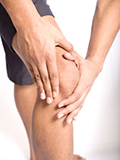
If you have knee pain, rest assured you are far from alone. Each year 6 million Americans head to the doctor for knee pain issues. This translates into 2.5 percent of the U.S. population sitting in doctors’ offices for relief of knee pain. Even more people try to self-diagnose and treat themselves with pain pills, anti-inflammatories and home remedies.
A U.S. study found that 18% of men aged 60 years and older reported knee pain, and that percent goes up as we age. Women experience knee pain even more than men.
But it’s important to remember that pain symptoms are typically a warning mechanism to our brains that something is wrong that needs to be addressed. Simply masking pain symptoms with drugs, or even just anti-inflammatories, can have long term impact on internal organs and one’s lifespan. Masking symptoms can also encourage the person to further overuse and injure their knee joint.
Consequently, it’s important to address knee pain symptoms early on to determine if there are non-surgical or surgical treatment options that can relieve pain symptoms without drugs or pills.
Step #1 is understanding the complex knee joint and how it works so you can better relate to treatment options that may be recommended by a knee specialist.
Knee anatomy
The knee is a complex mechanism which absorbs shock as we jump, and is extremely flexible, permitting a change in direction while running at high speeds. The knee joint is composed of ligaments, which provide support, and muscles for strength.
The healthy young knee joint is a lubricated mechanism, which functions reliably unless twisted, bruised or broken. For example, of all the areas treated by orthopedic surgeons, the knee is the most commonly injured joint, representing 26 percent of orthopedic visits, followed by the spine (17 percent) and hip (15 percent).
Some cases of knee pain are caused by trauma, such as a fall or a car crash. According to the American Academy of Orthopedic Surgeons (AAOS), over a lifetime, each American will suffer two fractures. Many of which will occur at the knee.
However, trauma or fracture represents a small percentage of knee problems. The majority result from repetitive wear and tear. In these cases, the cartilage or joint surfaces are slowly damaged over time. One type of chronic injury is arthritis, which might be thought of as a “rusting” of the knee joint. It causes pain and robs the knee of flexibility. Indeed, half of all knee pain may be tied in some way to arthritis.
Cartilage is a natural lubricant tissue that helps your joints move smoothly. When cartilage begins to break down with age or injury, you experience bone-on-bone friction which causes symptoms like inflammation, knee pain, stiffness or inability to move the joint without extreme pain.
Many of the causes of osteoarthritis are out of a person’s control, e.g. heredity or accidental injury. But you can make lifestyle changes to reduce your risk of arthritis, ligament strain and a painful knee.
What causes knee pain?
Any mechanical device can and will fail if placed under excessive strain. That could be a fall down stairs or banging the knee into a dashboard during a car accident. But again, accidents and falls represent a relatively small percent of knee pain cases.
The vast majority of knee pain issues develop over a period of years. In these cases, the knee becomes like a creaky or unstable hinge that doesn’t get better, either because components in the knee are weak or unstable, or the lubrication in the joint and bone surface have been eroded over time.
That’s the bad news. The good news is that of all knees that hobble into doctors’ offices every year, only 20 percent will need surgery. Of those that don’t need surgery, many can get better with time and new non-surgical treatment options.
In some cases anti-inflammatories and specialized exercises increase range of motion, flexibility, strength, and resistance to future knee strain are usually prescribed. Sometimes knee braces are also used.
How a person causes their own knee pain
In 2020 Americans breeched a new undesirable record. The U.S. Government’s Centers for Disease Control (CDC) estimates that 42% of Americans are now classified as “obese” according to weight tables. This is a dramatic increase from 20 years ago in year 2000 when only 30% of Americans were “obese.”
A man 5’9” weighing more than 200 pounds is technically “obese” compared to normal weight of up to 168. (You can measure your own weight at: https://www.calculator.net/overweight-calculator.htm ) Sadly, the American culture has become more sedentary than other cultures and more prone to eat high carb foods with larger portions. Fact: there are more obese adults living in America today – 78 million – than in any other country in the world.
At the same time we are getting heavier, more of us could be classified as the “weekend warrior”. These are the middle-aged woman or man who works a desk job during the week, and then on Saturday morning jumps into a full-blown weekend of physical activity. Not surprisingly, by Sunday evening, these warriors are often trying to mask the damage done to their knees with pills and ice packs.
Accordingly, orthopedic surgeons are discovering new ways — NON-surgical as well as surgical — to repair or replace the worn out knee.
Your current choices will affect your retirement
When you are 80 years old, will you be frail and brittle and wheelchair-bound? A lot depends on the choices you make from age 30 onward. The more you lose control of your weight and place more and more strain on your knees, the more likely you will damage your knee joint.
This in turn limits your ability to be active and to keep weight off. This is the beginning of the vicious disability cycle: The less active you are, the more weight you gain, which makes movement even more uncomfortable.
When golfing, riding in a cart is certainly easier than walking and carrying clubs on your back or pushing a cart. But those are the choices that can dictate your level of activity years later in retirement.
While there are certainly exceptions, and skinny people can certainly have arthritic knees, the reality is that most knee replacements are done not on skinny people, but those who are obese, or worse, morbidly obese.
The knee joint is simply not designed to carry that much weight and it’s just a matter of time before the joint is destroyed. While orthopedic surgeons will recommend a knee replacement patient to lose weight before surgery, most don’t, and they then wear out the artificial knee prematurely which in turn requires more complex revision surgery for a second artificial knee joint surgery.
Risk of knee problems
Aging baby boomers might also be of higher than normal risk, where poor conditioning matched with overuse, joint strain, and joint degeneration can combine with the natural onset of arthritis.
Women may not play much football, but they have plenty of knee problems. The American Journal of Sports Medicine reports that women injure their anterior cruciate ligament (ACL) four to eight times more often than men. Why? It’s thought that the menstrual cycle and estrogen levels may increase risk of knee injury. Other theories relate to high heel shoes and tripping.
Differences in pelvic structure between men and women may also be an issue. A woman’s pelvis, which is wider, creates a sharper angle between the calf and thigh, increasing pressure on the knee. In addition, a woman’s kneecap rides in a shallower groove, making the mechanism less stable. Another factor discovered by researchers at the University of Michigan is that women don’t use their quadriceps and hamstring muscles in the same way as men. Men are equally reliant on the quadriceps and hamstrings, whereas women tend to rely more on their quadriceps during sports activities.
While overweight women are most often the ones to need a knee replacement for worn-out knees in their sixties, simple knee injuries occur more frequently in men. In fact, knee pain is one of the top ten reasons men see a doctor. Overall, knee pain occurs more in men because they participate more in sports, and they find knee pain stops them in their tracks.

Do you Need an Appointment?
We have made it easier to schedule appointments, click the button to fill out an online appointment request form or call our new central scheduling line 401-457-1500 to schedule an appointment.
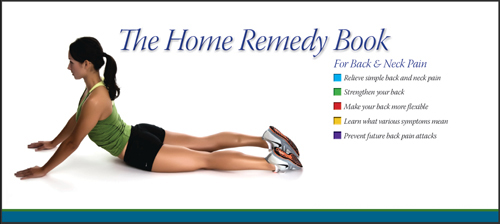
Home Remedy Book
Have back or neck pain? Learn what causes symptoms and the home remedies that relieve pain. University Orthopedics mails out Home Remedy Books to residents throughout the New England area.